China's Industrial AI: Lessons for Energy and Mining Leaders
Compare industrial AI in energy and mining through asset conditions, failure costs, sensor quality, maintenance response and safe operating boundaries.
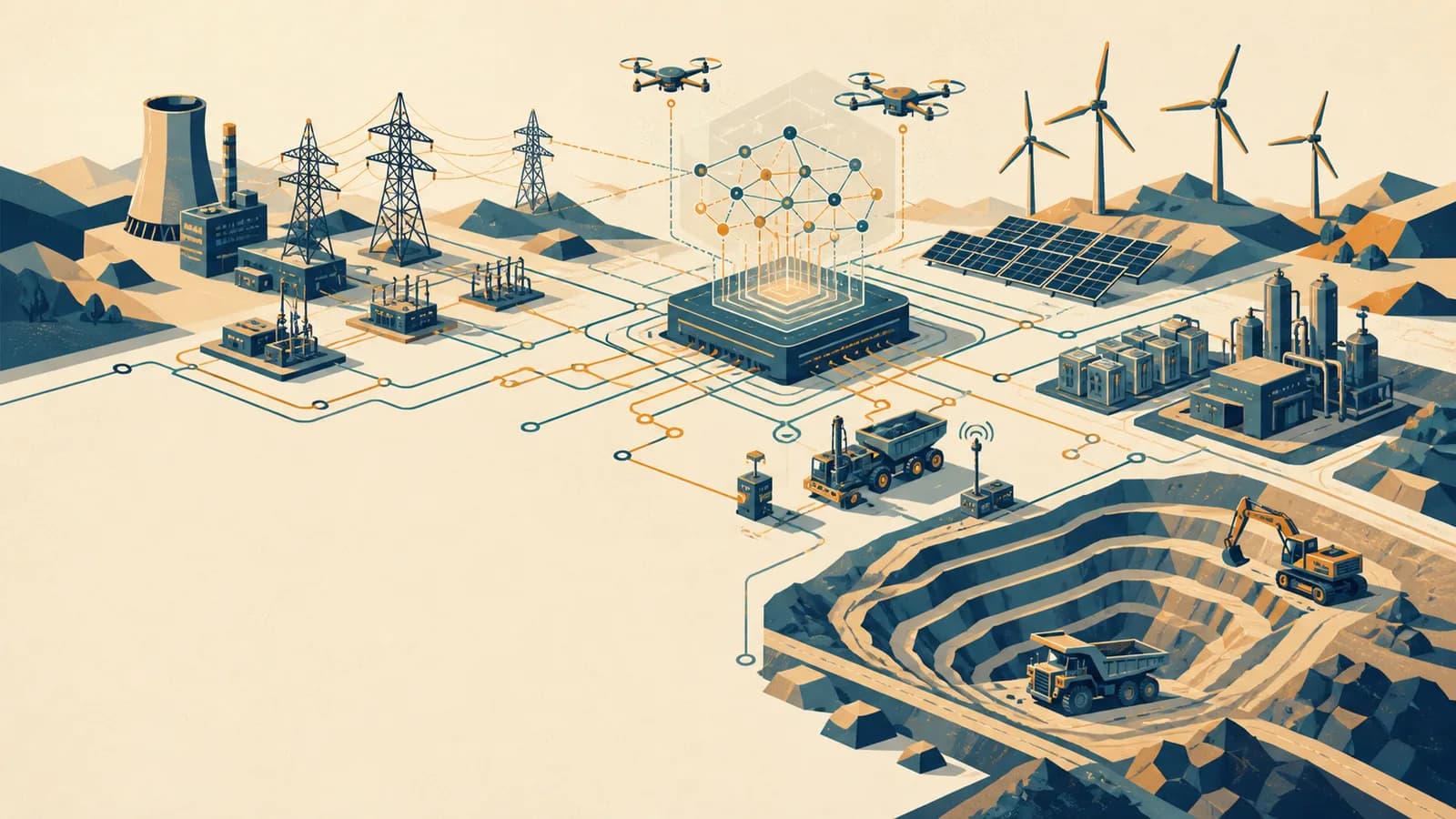
Energy and mining applications often depend on physical conditions that differ sharply between sites. Compare the asset, failure mode, sensing environment and response process before transferring an AI approach. A prediction has limited value if the maintenance team cannot inspect the asset or obtain the required replacement part.
What to evaluate
Asset intelligence
Connect sensing, inspection and prediction to maintenance and reliability workflows.
Operations optimisation
Examine dispatch, scheduling, blending, grid or process decisions.
Autonomy boundary
Understand remote operation, human supervision and fail-safe design.
Energy-data trade-off
Measure the energy demand of AI alongside efficiency and emissions opportunities.
Worked evaluation exercise
The following is an illustrative assessment exercise, not a reported customer result.
For predictive maintenance on a pump, define the failure event, warning window and action that follows an alert. Count false alarms, missed failures and unnecessary inspections. Compare operating loads and maintenance history with the host's example rather than assuming identical behaviour. A shadow-mode test can gather evidence without allowing a new model to control equipment. Site engineering and safety teams should determine the conditions for any operational change.
Questions for the operating team
- Which operational constraint is represented in the model?
- How is safety authority preserved during automated operation?
- What local data is required before transfer is credible?
Warning signs
- Computer vision shown without response workflow.
- Autonomy claims without edge-case evidence.
- Efficiency gains that omit compute and integration costs.
Planning the visit
Use these questions to scope an industry-focused China AI program. Agree which records and operating workflows can be examined before confirming meetings; host participation and access require confirmation. Our research method explains how we structure the brief and follow-up.
References and scope
These references provide policy or risk-management context. They do not independently verify a host's performance or the illustrative exercise above.