China Robot Fleets: Check the Shared Station Before Adding Robots
Two robots that each handle 30 tasks an hour alone may share a station that can serve only 40. Measure the common constraint before buying more fleet capacity.
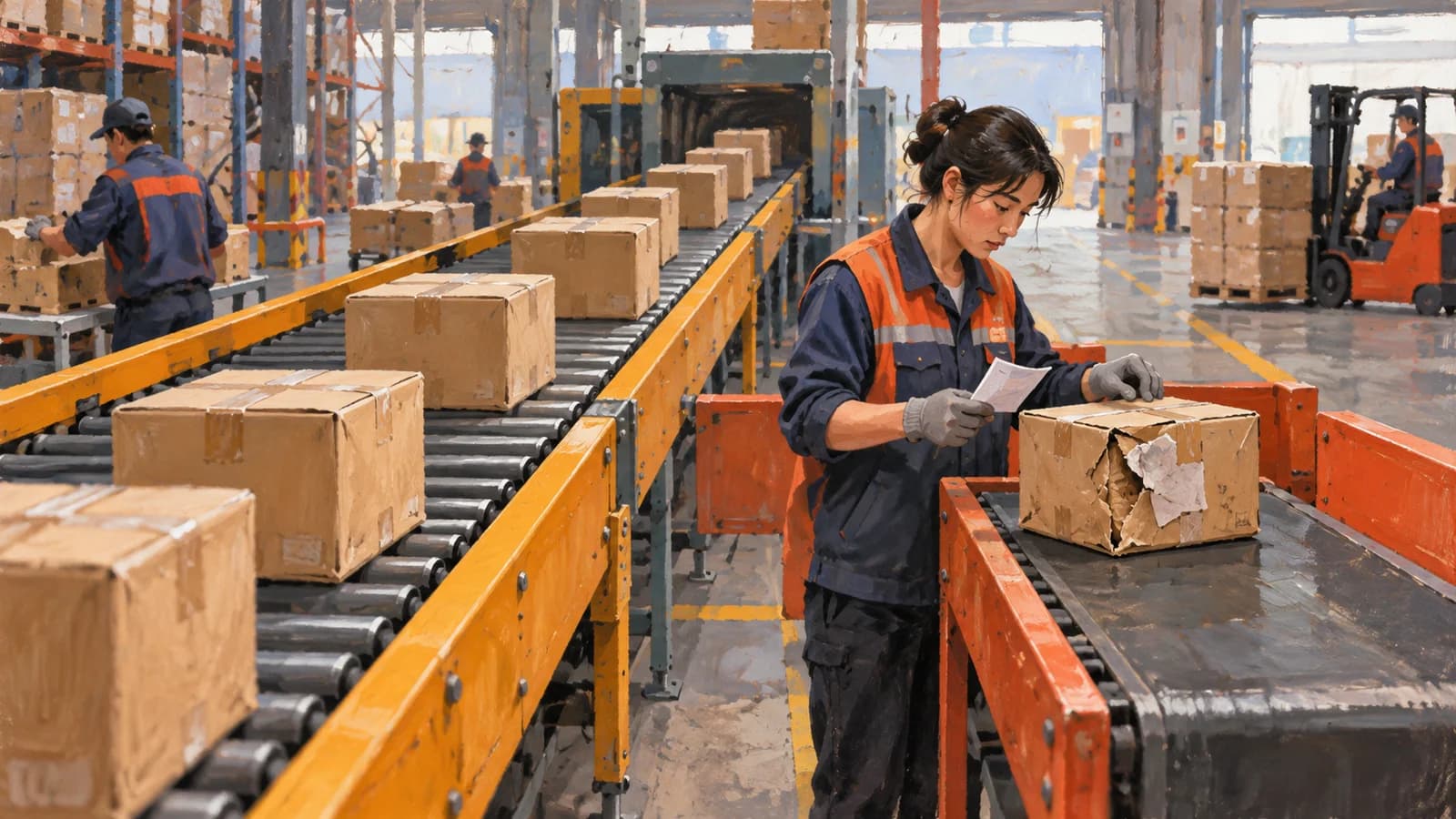
Two robots each complete 30 tasks an hour when demonstrated alone. It does not follow that they will complete 60 together. If both need the same transfer station, inspection point or receiving operator, that shared resource may limit the combined workflow.
During a China robotics evaluation, ask for a fleet-level observation using the intended task mix and shared equipment. Compare unique accepted tasks over the same scheduled window, then trace the time spent waiting for the common resource. Adding individual robot rates is a proposal to test, not a capacity result.
Put the shared step inside the measurement boundary
Draw the route from task release to accepted delivery. Mark which steps can run independently and which require exclusive use of a station, person or other resource. Specify whether a robot remains occupied while its task is being served there.
Use existing logs, a host-approved simulation or a controlled test fixture. Site personnel determine safe operating arrangements; visitors should not change traffic controls, obstruct routes or disable interlocks to provoke congestion.
Give each task and robot a stable identifier. At a shared station, record arrival, service start, service end and release. Link that visit to the final acceptance record. A robot arrival or a station cycle is not automatically a completed customer task.
Calculate a ceiling before promising a fleet gain
Consider a hypothetical transfer workflow. Each accepted task requires exactly one visit to a single station. The station serves one task at a time and occupies 90 seconds per visit, including its changeover and release. Assume it is available throughout a 60-minute window, with no partly completed task at the start. No task can bypass it.
Even with work continuously available, that station can finish at most 3,600 / 90 = 40 visits during the hour. Because every accepted task needs a visit, accepted task output cannot exceed 40 under these assumptions. Additional delays or quality failures may reduce it further.
Suppose the individual demonstrations each reported 30 accepted tasks per hour using exclusive access to the same station. The comparison becomes:
| Configuration | Sum of isolated robot rates | Shared-station ceiling | What remains to measure |
|---|---|---|---|
| One robot | 30 tasks/hour | 40 visits/hour | Actual accepted output and station idle time |
| Two robots | 60 tasks/hour | 40 visits/hour | Contention, scheduling and final accepted output |
| Three robots | 90 tasks/hour | 40 visits/hour | Whether another robot reduces a remaining gap or only adds waiting |
The 40-visit figure is a ceiling, not a prediction that two robots will achieve it. Travel, synchronization, available inputs and handoff rules may prevent the station from staying busy. The single-robot result also does not show that another robot is useless: an additional robot might keep the station supplied during the first robot's absence.
The useful supplier question is which observed gap another robot would close. If the station is already fully occupied by useful work, adding robot capacity alone cannot raise this ceiling. If the station often waits for a robot, a fleet trial can test whether another unit changes that pattern.
Observe one, two and three robots on comparable work
Keep the station, task mix, acceptance rule and scheduled duration constant. Repeat the configurations across representative observation windows and retain startup and ending conditions. Record any added operator or changed station setting separately; those changes could explain an apparent fleet gain.
Reconcile the station's single clock into service, changeover if not already included in service, faults and waiting. Do not count a changeover twice. Keep each robot's waiting time separately: two robots waiting together for ten minutes produce twenty robot-minutes of waiting, but only ten minutes on the station's clock.
Retain unfinished work at the cutoff. A configuration can appear busy while leaving more tasks queued. Show the starting backlog, tasks released, accepted completions, rejected or cancelled tasks and unresolved ending work, with identifiers that prevent duplicate counting. The good-units-per-shift guide explains the distinction between processing attempts and unique accepted output.
Inspect fairness as well as the fleet total
Split results by robot, route and task priority. An unchanged fleet total can conceal one route waiting much longer while another receives most station access. Record arrival-to-service waiting and deadline outcomes for the relevant groups, rather than reporting only a fleet average.
Ask the operator to explain the actual dispatch rule and its behavior when one task cannot proceed. Use a recorded incident or simulation for that discussion. The warehouse exception guide follows ownership and reconciliation when work needs intervention.
NIST AI RMF 1.0 (2023), MEASURE 2.1 calls for documenting test sets, metrics and evaluation tools. For this exercise, retain the shared-resource map and the task-linked timing records alongside the fleet configuration.
Leave the evaluation with measured accepted output, unfinished work and a named constraint. That evidence can support a decision about another robot, a station change or a scheduling trial without confusing movement with delivered capacity.
From the Wire
News behind the questions
Driving ·
Uber and Momenta begin free Munich Robotaxi pilot with safety operators ↗
Uber and Momenta have started a free Munich Robotaxi pilot, IT Home reports. Access is limited to registered participants, and trained safety operators accompany every journey.
Robotics ·
Robot Era's M7 robots enter 11 China Post nodes across Guangdong ↗
Robot Era's M7 logistics robots are operating at 11 China Post nodes across eight Guangdong cities, according to a November 17 report. Reported throughput exceeds 1,500 parcels an hour; the report gives no Guangdong robot total.
Robotics ·
Report examines Astribot's CoMind approach to robot cooperation ↗
A QbitAI analysis describes how Shenzhen-based Astribot's CoMind framework selects task-relevant information for robots making separate action decisions, drawing on company demonstrations.