How to Pay in China: A Reliable Payment Plan for International Visitors
Build a resilient China payment setup using Alipay, Weixin Pay, international cards and RMB cash—plus a recovery plan for app, network or issuer failures.

Direct answer. The most reliable way for an international visitor to pay in mainland China is to prepare four layers: Alipay with an eligible international card, Weixin Pay as a second wallet, at least one physical Visa or Mastercard, and a modest amount of RMB cash. Mobile wallets cover many everyday QR-code purchases; cards and cash provide recovery when an app, network, issuer or merchant flow fails.
Key takeaways
- Link eligible international cards to both Alipay and Weixin Pay before departure.
- Keep the original mobile number active for security messages, even if a travel eSIM supplies data.
- Expect QR payments to be more useful for everyday purchases than swiping a foreign card directly.
- Use merchant payment flows; do not assume a foreign card can fund personal transfers or wallet balances.
- Carry a physical card and RMB cash, and agree a group-expense process before an executive delegation begins.
Checked: 14 August 2026. Payment apps, supported cards, fees, limits and local acceptance change. Verify the current app prompts, merchant signage and card-issuer terms before relying on a method.
What payment methods can foreigners use in China?
China's official guidance describes a mixed payment environment rather than a mobile-only system. Overseas visitors can use mobile payments, bank cards and RMB cash. They may also find UnionPay products, e-CNY or supported overseas wallets useful in particular situations.
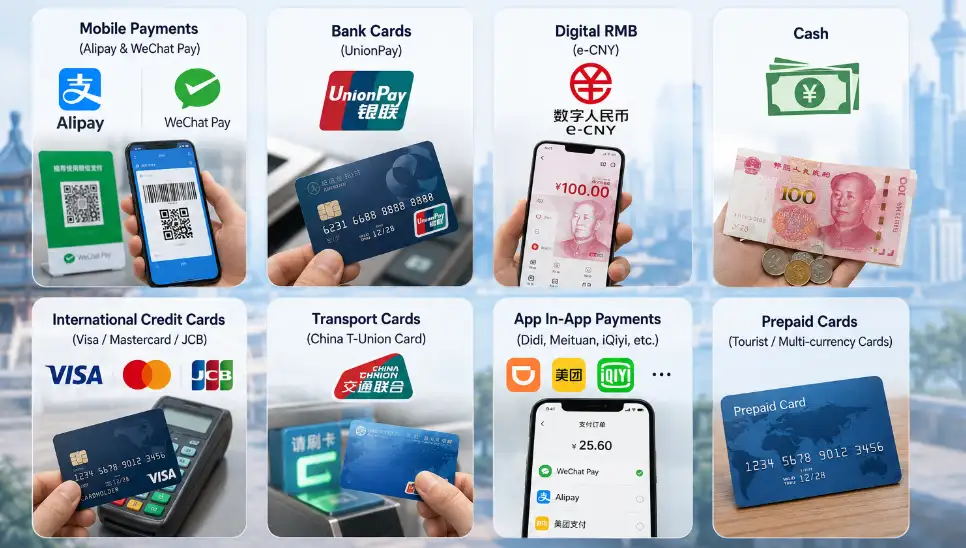
A visual overview of common payment methods in China. Source: Trip.com China payment guide.
| Method | Best use | Main limitation | Role in your plan |
|---|---|---|---|
| Alipay | Everyday merchant QR payments, transport and travel mini-apps | Some features or QR types may not accept an overseas-card-funded payment | Primary mobile wallet |
| Weixin Pay | Merchant payments inside WeChat and service mini-programs | Personal transfers and wallet features may have different eligibility | Secondary mobile wallet |
| Physical international card | Hotels, larger merchants, staffed ticketing and deposits where the card logo is accepted | Direct acceptance is less consistent at small businesses | High-value and recovery option |
| RMB cash | Universal offline fallback and small purchases | Change may be inconvenient and cash cannot open app-only services | Essential backup |
| Supported overseas wallet | Convenient where cross-border QR interoperability is enabled | Country, wallet and merchant coverage varies | Optional alternative |
| e-CNY or prepaid product | Useful for travellers who understand the product and eligibility | Extra setup, top-up and refund rules | Optional, not a first requirement |
The strategic principle is redundancy. No single method fails everywhere, but no single method works in every context either.
What should you set up before travelling?
1. Prepare two mobile wallets
Install Alipay and WeChat from official app stores. Register with your overseas number, complete identity verification when requested, and link eligible international cards. Use different issuers across the two wallets if possible so one bank's fraud control does not disable both.
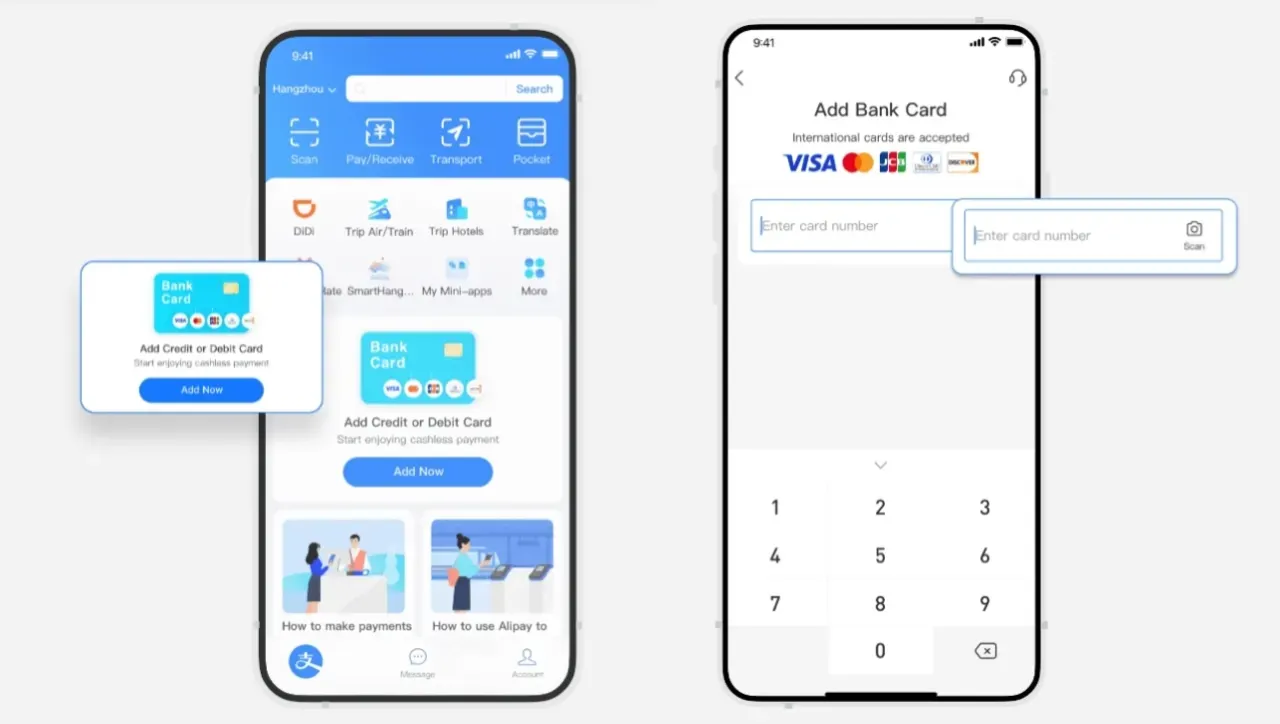
Example of adding an international card in Alipay. Source: Trip.com China payment guide.
Follow the detailed Alipay guide for international visitors and Weixin Pay setup guide. Do not wait until the first airport transfer to discover that your issuer requires an authentication method you cannot access abroad.
2. Keep your security channels working
A travel eSIM can provide convenient data, but it may not receive messages sent to your home number. Keep the original SIM active or confirm another approved bank-authentication method. Download issuer apps, update passwords, and store customer-service contact details before departure.
3. Carry more than one physical card
Bring cards from different issuers or networks where practical. Keep them separately. Enable international transactions if your bank requires it, and know the card PIN in case an ATM or terminal asks for it.
4. Obtain a modest amount of RMB
RMB cash can be obtained through authorised exchange services or withdrawn from compatible ATMs. Carry smaller notes for transport or a merchant that cannot provide change for a large denomination. Do not carry more cash than your risk policy permits.
5. Plan phone power and connectivity
Mobile payment depends on a charged phone. Carry a compliant power bank and charging cable. Keep hotel names, meeting locations and emergency contacts in an offline note; a payment failure and a navigation failure often share the same cause.
How do QR payments work in mainland China?
There are two standard merchant flows.
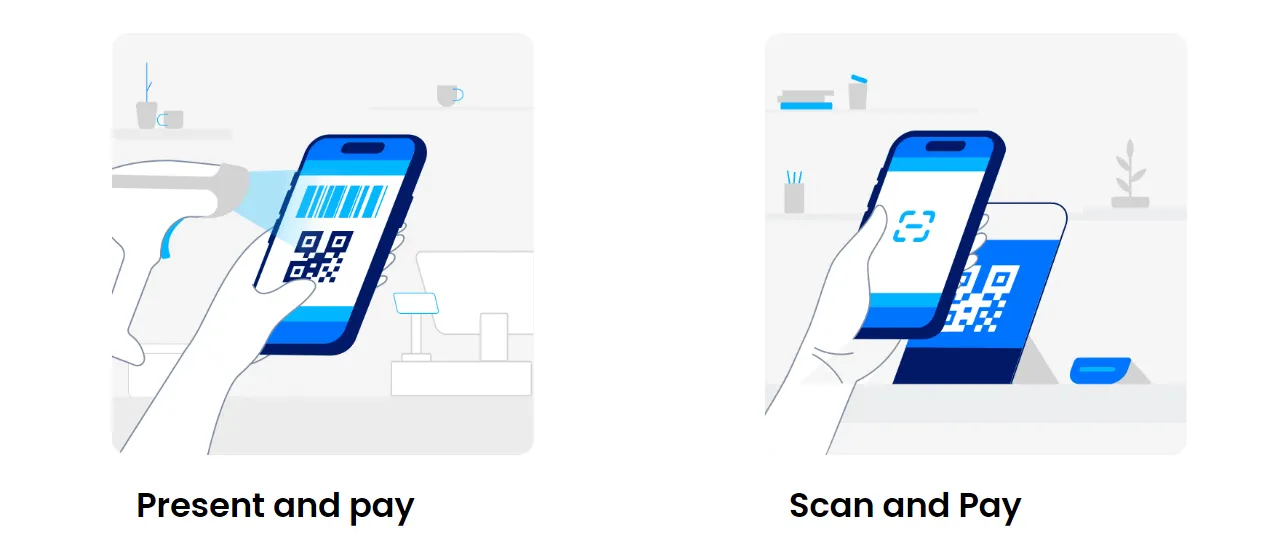
The two standard QR-payment flows: present your code or scan the merchant's code. Source: Trip.com China payment guide.
Merchant scans customer. Open the wallet's payment code and let the cashier scan it. This is efficient at supermarkets, convenience stores and staffed counters.
Customer scans merchant. Open the wallet scanner, scan the merchant's code, enter the amount if required, verify the merchant identity, and confirm. This is common at local restaurants and smaller shops.
These are commercial payment flows. A code associated with an individual can be treated differently from a merchant checkout. If a foreign-card-funded wallet rejects the code, request another method rather than assuming the entire wallet is broken.
Can you simply tap or swipe a foreign card?
Sometimes. Hotels, airports, major attractions, large shopping areas and international businesses are more likely to accept international cards directly. Look for the relevant network logo and ask before committing to a purchase or deposit.
Do not generalise that experience to every restaurant, taxi or small shop. QR-based mobile payments are often the smoother everyday method. The Chinese government's practical formulation is useful: cards for larger payments, QR codes for smaller payments, and cash as a backup.
For hotel deposits, ask whether the property accepts your card network, whether the deposit is a pre-authorisation or completed charge, and how long release normally takes. A wallet payment may not replace a physical card for every deposit workflow.
Is cash still accepted in China?
RMB cash remains a legitimate payment method and is an important contingency. In practice, a small merchant may prefer QR payment or have limited change. Carry smaller notes, state clearly that you want to pay cash, and allow extra time.
Cash is especially useful when:
- the phone is out of power;
- mobile data is unavailable;
- the card issuer blocks a wallet transaction;
- a merchant QR type does not support the linked overseas card;
- a station, machine or local service has a temporary system problem;
- a group needs to resolve a small time-critical expense immediately.
Cash is less helpful for app-only ordering, online tickets and some ride-hailing flows. It is a backup layer, not a substitute for digital preparation.
How should you pay in common travel scenarios?
Airport arrival
Use a pre-arranged transfer, official taxi flow, wallet ride-hailing service or a staffed transport counter. Avoid depending on a new account setup while standing in the arrivals hall. Keep the hotel name and address in Chinese.
Hotels
Confirm card acceptance and deposit policy in advance. Keep a physical card available even if the room was prepaid. Ask for the correct business receipt if the stay is reimbursable.
Restaurants and coffee shops
At a staffed counter, present the wallet payment code. At a table, a QR code may open a menu and checkout mini-program. Verify that the total, table and merchant are correct. If the mini-program requires local details, ask staff for a direct payment code or card terminal.
Taxis and ride-hailing
App-based ride hailing usually settles through the selected wallet or linked card. For street taxis, clarify the payment method before the end of the trip. Keep cash as a fallback and request a receipt where required.
Metro and buses
Some cities allow mobile transport codes, ticket machines, transit cards or contactless foreign cards on selected networks. The method varies by city. Check the local transport system rather than assuming one national rule.
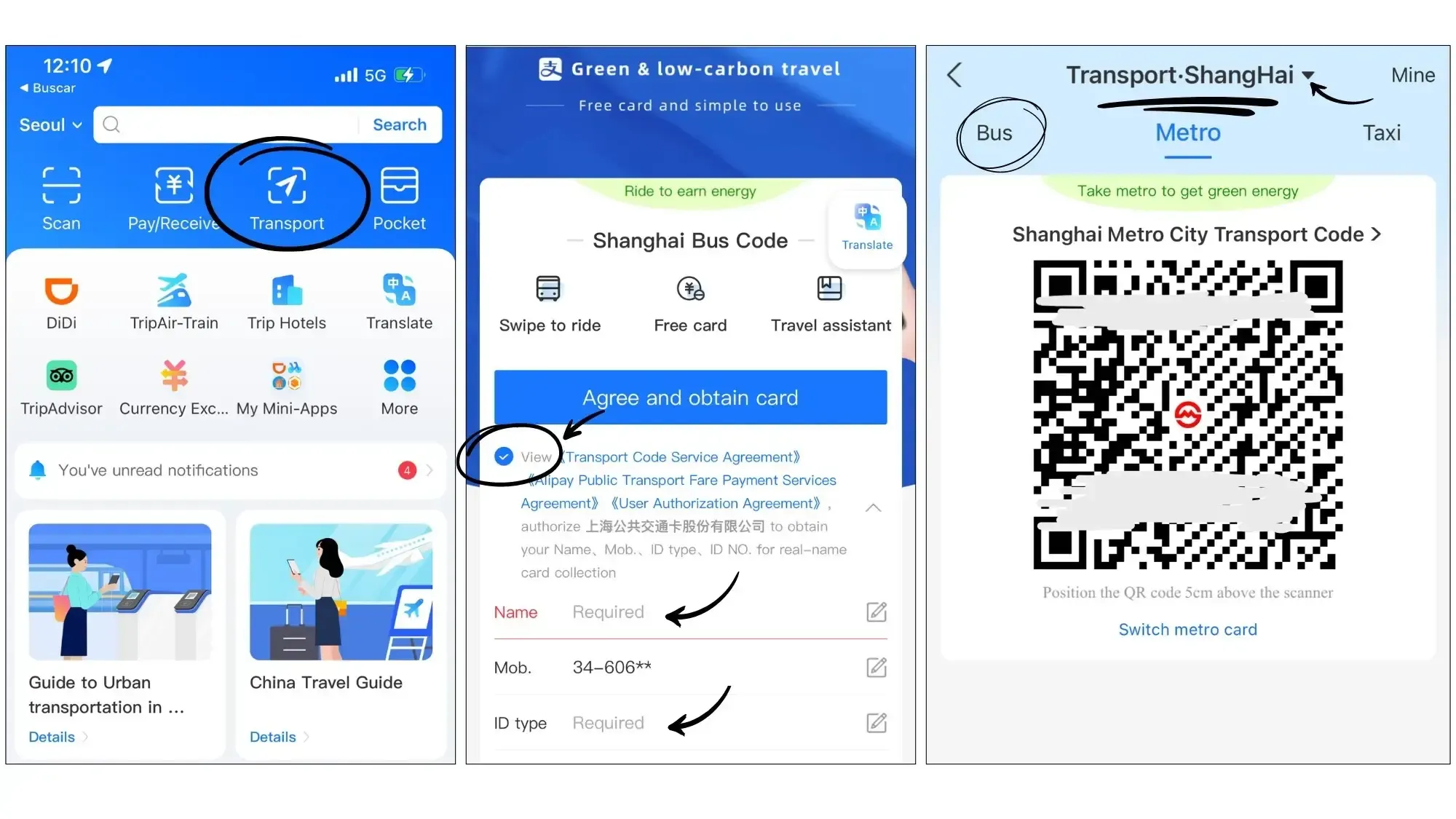
Example of activating a city-specific transport code in Alipay. Source: Trip.com China payment guide.
Trains and flights
Use official or established booking platforms, confirm that the traveller's passport details match the ticket, and retain the payment record. Staffed channels may offer additional card or cash options when an online flow fails.
Hosted business dinners and private services
Agree who is paying before the event. A supplier, local host or programme organiser may be using a commercial account, while a traveller's personal wallet may not support reimbursement to an individual. Avoid improvised transfers after a large dinner.
A payment plan for executive delegations
Executive travel adds group timing, duty of care, reimbursement and information-security requirements. A robust private China AI executive immersion should have an explicit payment operating model.
Traveller-level controls
- Each traveller sets up at least one wallet and one physical card.
- The original mobile number remains available for issuer verification.
- Transaction alerts and device biometrics are enabled.
- Receipts are captured at the time of purchase.
- Personal and company expenses are kept separate.
Group-level controls
- At least two people hold functioning wallets funded by different issuers.
- A programme lead holds a backup corporate card and RMB cash.
- Larger purchases have a named approver.
- The itinerary identifies app-only services and deposit requirements.
- Emergency transport can be paid without relying on one traveller's phone.
- Lost-device and card-blocking contacts are available offline.
This preparation belongs in the programme design and evidence process, not in an informal message on the morning of departure.
What causes payment failures, and how do you recover?
| Failure | First check | Recovery |
|---|---|---|
| Wallet app cannot connect | Mobile data, app permission, local network and phone time settings | Switch connection, use the second wallet, then card or cash. |
| Card cannot be linked | Issuer approval, supported card, identity details | Contact the issuer or add another eligible card. |
| Linked card is declined | Issuer fraud alert, limit, merchant category, recent duplicate | Check whether a charge completed, approve the bank alert, then use a different method. |
| Merchant code fails | Merchant versus personal QR type, unsupported funding source | Request a normal merchant checkout, alternate wallet, terminal or cash. |
| Phone battery is low | Power source and travel time remaining | Use a power bank before entering a time-critical journey; preserve cash for recovery. |
| Account enters security review | Official app instruction and identity status | Do not use third-party unlock services; move to the backup method while resolving it. |
| Receipt is missing | Wallet history, merchant order and card statement | Capture the transaction reference and ask the merchant immediately. |
Never retry blindly. A delayed confirmation can lead to duplicate charges. Check the wallet history and card alert before paying again.
How do fees and exchange rates work?
A payment may involve more than one pricing layer:
- the price charged by the merchant in RMB;
- any service fee shown by the wallet;
- the card network's currency conversion;
- an issuer foreign-transaction fee;
- a cash-withdrawal or ATM fee, if applicable.
Current thresholds and promotions change, so evergreen planning should not depend on a specific percentage copied from an old article. Review the final wallet screen and the issuer's current terms. Where a terminal or app offers a home-currency conversion, understand the rate before selecting it.
For business expenses, the cheapest method is not always the most auditable. A method that produces a clear merchant record, tax invoice and card statement may be preferable to an informal personal payment.
Security rules for digital payments in China
- Download only official wallet and banking apps.
- Use device biometrics, a payment password and transaction alerts.
- Never share a live payment code, password or one-time bank code in chat.
- Verify the merchant name and amount before approving.
- Do not send passport images to a person offering account help.
- Keep card-blocking numbers and passport copies in an approved secure location.
- Use company policy for wallets, receipts and confidential business communications.
- Check the payment history before retrying a transaction that appeared to time out.
Frequently asked questions
What is the best way for a foreigner to pay in China?
Use Alipay as a primary mobile wallet, Weixin Pay as a second wallet, and keep a physical international card plus RMB cash. This covers more scenarios than any single method.
Do foreign Visa and Mastercard cards work in China?
They can be linked to supported mobile wallets and can also be used directly where the merchant displays the relevant card-network logo. Direct acceptance varies by merchant and location.
Can I use Apple Pay or another home wallet everywhere?
No. Acceptance depends on the wallet, card, city and merchant. Some cross-border wallet integrations are available, but Alipay or Weixin Pay plus a card and cash remains the more general preparation.
Do I need a Chinese bank account?
Short-term visitors can generally pay eligible merchants by linking an international card to Alipay or Weixin Pay. A mainland bank account may be required for broader wallet, balance or person-to-person functions.
How much cash should I carry?
Carry enough RMB to cover a practical fallback such as local transport, a meal and a short disruption, while staying within your personal or corporate risk limits. Smaller notes are more useful than one large note.
Will the same transit payment work in every city?
No. Metro and bus payment options vary. Select the correct city in the wallet and check local signage or official transport guidance.
Sources and further reading
- Trip.com: How to Pay in China for Foreigners
- The State Council of China: Guide to Payment Services in China
- The State Council of China: Guide to Working and Living in China
- The State Council of China: Payment Service Guide for Overseas Visitors
This guide is general travel preparation, not financial advice. Payment acceptance is determined by the platform, merchant, card network and issuer at the time of use.